

Before the Cake, the Ledger
On America’s 250th birthday, reflecting on the debt this country still owes.

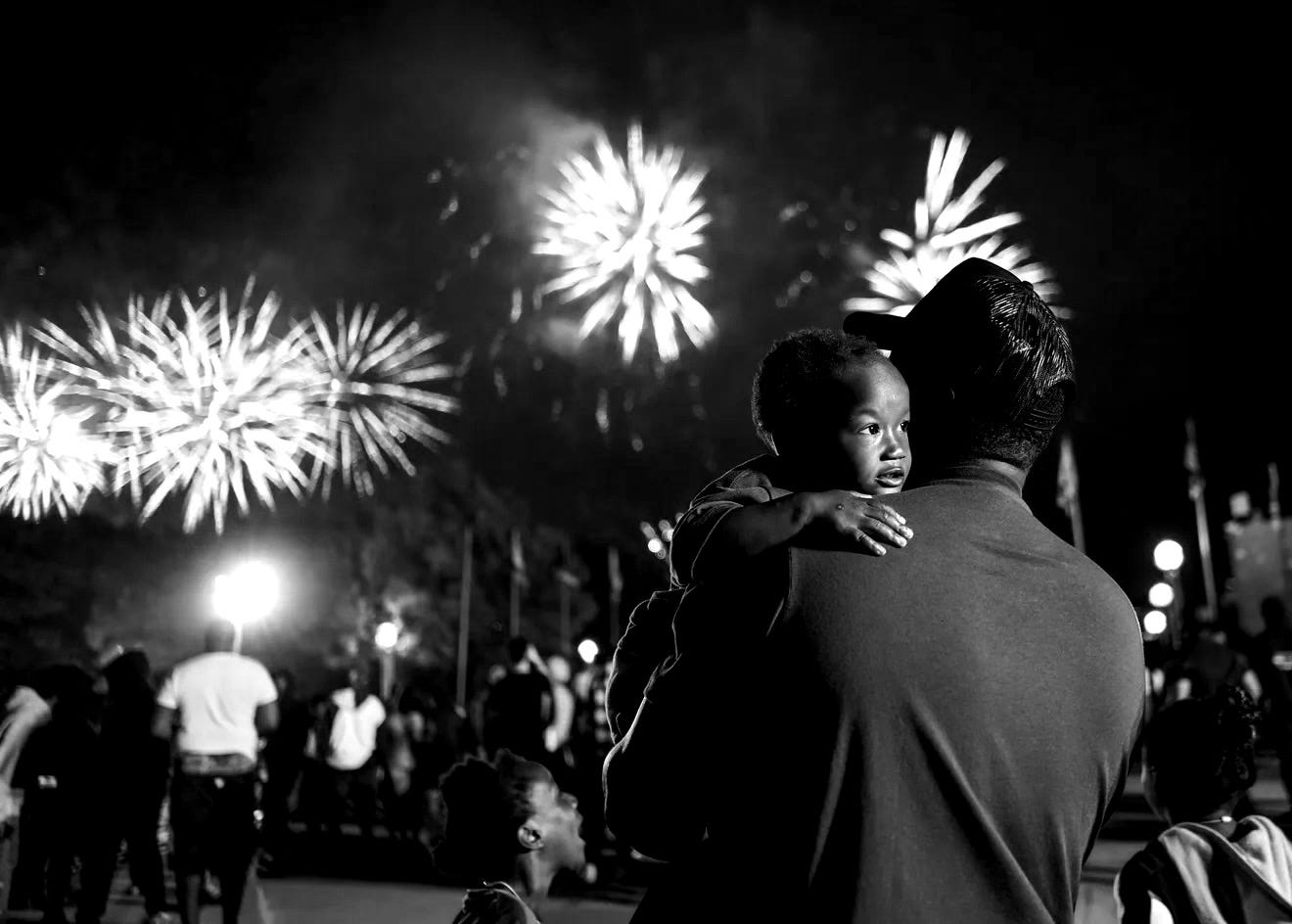
When people ask whether I celebrate the Fourth of July, I have to tell them what fire has meant in my family.
Not fireworks. Fire.
Fire as verdict. Fire as policy. Fire as a mob’s signature. Fire as the language white men used when Black prosperity had become too visible to ignore. Fire as the thing that came for my great-grandfather’s store in Orangeburg, South Carolina, a store that was not merely a store but a beginning, a foothold, a proof.
His name was Richard, and he was a preacher and a store owner, which meant he held two kinds of power white supremacy has always feared in the hands of a Black man: a pulpit and a cash drawer. On Sunday, he could speak to the soul. During the week, he could tend to the books. He could tell his people God had not abandoned them, then stand behind a counter and prove that neither had they abandoned themselves.
I do not know everything that was on those shelves. Family history often reaches us the way smoke reaches a room: shapeless at first, then everywhere. I do not know if there was flour, tobacco, cloth, candy. I do not know whether there was a bell above the door, what hymn lifted the roof on Sundays, or what scripture he returned to when the world was being itself again.
But I know this: the store existed. The pulpit existed. The promise existed.
Then white men came and burned it down.
And then they lynched him.
I write that sentence and feel how language fails twice: first because it cannot hold what happened, and then because it has been forced to hold it so often that the horror risks becoming familiar. Lynched. A word with a rope in it. A word with a crowd in it. A word with a courthouse nearby pretending not to see. A word with children growing old around the silence it leaves behind. A word America wants to place safely in the past, as though the past were a locked room and not a bloodstream.
My great-grandmother, Hester, had to flee. She had to leave a life built in the South, a beginning of economic prosperity pulled up out of the throes of enslavement and sharecropping, because the country that now asks me to celebrate its freedom once looked at a Black man with a store and a sermon and decided he was too free to live. And with that loss—many futures were set on fire.
This is what I need America to understand before the cake is cut: my family did not simply become poor. We were robbed of becoming.
People speak of generational poverty as if it were a weather pattern, as if it gathered mysteriously over certain neighborhoods and not others, as if it were made of bad habits instead of bad history. They ask why a family did not save, why it did not buy, why it did not stay, why it did not pass down, why it did not climb. They ask these questions as if Black people have not spent centuries beginning again in the shadow of someone else’s violence. My great-grandfather had worked. He had preached. He had saved. He had owned.
They burned it down.
That is not an anecdote. That is an economic event. That is not merely family tragedy. That is American history in its work clothes. A lynching was not only murder; it was wealth destruction, civic terror, labor discipline, racial theater, spiritual warfare, inheritance interrupted. The men who killed him did not only take one life. They killed a set of verb tenses: what he would have bought, what she would have kept, what their children would have inherited, what their children’s children might have taken for granted.
The smoke kept traveling. It traveled north with my great-grandmother. It traveled into rent instead of ownership, into wages without cushion, into children raised inside a future already narrowed by somebody else’s match. It traveled into New York. It traveled into the projects.
My family did not simply arrive in the projects. We were routed there. Right to the addresses of an interrupted inheritance. Brick towers holding Southern ghosts.
By the time my generation entered the world, the store in South Carolina was no longer standing, but its absence was. And that absence decided what neighborhood I grew up in, what schools I attended, what emergencies became catastrophic because there was no cushion beneath them, what dreams I called unrealistic because the money that should have fed them was turned to ash before I was born.
So when America turns 250 and asks whether I will celebrate, I hear another question: will I agree to admire the candles without mentioning the fire?
The very question of whether I will celebrate mistakes me for a guest. But I am not a guest in a country my people built, prayed over, cooked for, cleaned, defended, grieved, enriched, musicalized, and morally enlarged. I am not a guest in a language my people bent toward truth. I am not a guest in a democracy my people have been forced, generation after generation, to rescue from the people who claim to love it most. I am not a guest at the table because my ancestors’ hands are in the wood, their breath is in the walls, their hymns are in the rafters, their names are missing from the deed, and their absence is still being paid for by their descendants.
The Fourth of July is a party being held in a house whose floor plan I know. No one needs to tour me through the rooms. I know where the bodies are.
I know where the store was.
Or rather, I know that there was a store, and sometimes that is the wound: to inherit proof without possession, story without building, ash without receipt.
Still, what remains is enough.
A Black preacher-store owner in South Carolina, close enough to enslavement and sharecropping for their dust still to be on the family’s shoes, had built something. White men burned it and lynched him. His widow fled north. The family’s beginning of prosperity was derailed. Generations later, we found ourselves in New York projects, not because the bloodline lacked ambition, but because ambition had once made the bloodline a target.
Tell me, then, what should I do with the Fourth of July?
When I was a child, before I had language for any of this, the holiday came to me first as heat and appetite. It came as smoke from a grill, music from a speaker, cousins playing freeze tag, an old head yelling at one of us to stop playing near the food. It came as foil lifted from pans, as hands moving with the ancient authority of people who know how to feed a crowd, as paper plates bending under ribs, baked beans, potato salad, corn, burgers, whatever somebody made because making food for others has always been one of our people’s ways of telling despair it does not own the day.
I remember being young enough to think fireworks were only fireworks. They were magic then, color cracking open above the rooftops, the dark sky briefly embarrassed by beauty. I did not yet understand why some adults winced after the loud ones. I did not yet know that people could hear two histories in the same explosion.
I only knew everyone looked up, and because they looked up, I looked up too.
Then I got older, and the holiday acquired shadows. The smoke from the grill began to mingle with other smoke. Fireworks became less innocent. The flag became more complicated, which is to say more American, which is to say less able to survive without interpretation. I learned that the men who spoke most beautifully of liberty did not always intend for the beauty to reach the people who needed it most.
Frederick Douglass understood this. He came to the national birthday party in 1852 and refused the cake. Invited to commemorate independence, he brought a blade made of language and asked, “What to the Slave is the Fourth of July?” That question still stands in the doorway, old and unembarrassed, refusing the nation’s attempts to decorate around it. Douglass did not say the ideals were worthless because America had betrayed them. He said the ideals were powerful enough to convict America of betrayal.
In other words, he did not throw the promise away. He sharpened it into evidence.
I live in the echo of that sharpening. I am not enslaved, but I am not free of the question. The question has changed its clothes, learned new laws, moved into different neighborhoods, updated its vocabulary, but it still knows where I live. What to the slave was the Fourth of July? What to the descendant of a lynched preacher and store owner is the Fourth? What to the family that had a Southern future burned out from under it? What to the great-grandchild living generations later with the consequences of an arson the country refuses to count as economic policy?
Here is the hardest confession: part of me still wants to love the country.
Not the lie of it. Not the innocence it keeps trying to perform. But the land, the language, the music, the stubborn possibility that survives the worst Americans. Part of me envies people who can stand for the anthem and feel only uplift, who can see a flag and not also see a coffin, a classroom, a courthouse, a body cam, a campaign speech, a neighborhood map drawn like a noose. Part of me wants the uncomplicated country I was promised as a child, the clean one, the one with brave founders and steady progress, the one where the moral arc bent because good people quoted it into submission. Part of me wants to be the kind of American who does not have to cross-examine his own affection.
But affection without memory is how a nation trains its victims to become its public relations department.
My great-grandfather’s hands held a Bible and handled money. Think about the danger of that. Think about the danger of a Black man who could speak of heaven and own something on earth. The store was not just commerce. It was a rebuttal. It was a sentence written in wood and inventory: We are not what you said we were. We are not waiting for freedom to become polite before we practice it. We are not sharecropping our children’s future forever. We are building.
Which is why the fire and lynching were not random. They were reminders.
They said: your progress is conditional. They said: your property is temporary. They said: your family’s future may proceed only until it offends us. They said: your Bible cannot save you from our rope. They said: we will decide how much freedom you can survive.
Which is why—before the cake, the ledger.
Let us count what was taken. Not in the vague, ceremonial tone America prefers when it speaks of racial harm, but plainly. A man’s life. A woman’s home. A business. A source of income. A center of community. A family’s local standing. The compounding value of ownership. The chance for a store to become two stores, for a building to become collateral, for collateral to become education, for education to become choice, for choice to become ease, for ease to become that ordinary freedom America has always hoarded like treasure.
My family story is not a side note to American history. It is one of the places American history did its work. The distance between a Black-owned store in South Carolina and generational life in New York public housing is not a mystery to be solved by lectures about discipline. Sometimes the distance is a lynching. Sometimes the distance is a match. Sometimes the distance is a widow with nowhere safe to grieve. Sometimes the distance is a country so skilled at destroying Black ascent that it can later blame the wreckage on Black failure.
Do not ask me to celebrate without this knowledge. Do not ask me to admire the fireworks and forget the fire. Do not ask me to clap for freedom while stepping over the ledger. Do not ask me to praise America for opportunities my family had already begun making before their fellow Americans came to take them away. Do not ask me to confuse survival with justice.
And yet, survival matters. I will not let the country steal that too. My great-grandmother fled, but she did not vanish. The family was wounded, but not ended. The store burned, but the desire to build did not burn. The preacher was killed, but the sermon traveled. It traveled into warnings, prayers, ambitions, refusals, and my own writing. This is the hardest part of my relationship to America: even after all that, survival still means something.
Because through it all, somehow, my people still made a country inside a country that made our belonging conditional. In our pocket country we made music. We made kinship out of proximity and necessity. We made a way for children to know which apartments were safe, which elders would correct you, which doors smelled like dinner, which corners held danger, which aunties were not aunties by blood but by jurisdiction. We made, in the shadow of interrupted inheritance, another kind of inheritance: the knowledge that nothing America takes is the whole of what we are.
Black life has always required a grammar large enough for contradiction. We can mourn and season the meat. We can critique the republic and make sure the children get extra watermelon. We can distrust the flag and still love the wind. We can know the country’s crimes and still claim the land where our dead are buried. We can look at the fireworks and remember the burned store without surrendering the sky to the men who lit the match.
But I will not surrender memory at the gate.
At 250, America is old enough to stop asking for birthday wishes and start reading the bill. It is old enough to know that Black poverty did not appear from nowhere. It is old enough to know that families like mine did not simply fail to accumulate wealth; wealth was burned out of our hands, taxed out, zoned out, terrorized out, locked out, appraised lower, paid less, policed more, and then studied as pathology. It is old enough to know that a housing project in New York may contain a store in South Carolina that never got to become a chain, a family house, a college fund, a cushion, a choice. It is old enough to know that racial terror was not only about hatred. It was about labor. Property. Power. Competition. The policing of possibility.
It was about the future.
That is why repair cannot be sentimental. It cannot be a holiday statement, a museum exhibit, a mural, a diversity slogan, an apology delivered in passive voice. Repair must be as material as the harm. A store was burned; wealth was lost. A man was lynched; a family was rerouted. A woman fled; generations paid rent in the country that owed them land, safety, continuity, time. I am not saying any check could resurrect my great-grandfather or return my great-grandmother to the life stolen from her. Some losses are too total for math. But the fact that money cannot restore everything does not mean nothing is owed. The fact that a ledger cannot hold the soul does not mean the ledger should stay closed.
Maybe this is why I continue to stay in America.
I stay as witness. I stay as creditor. I stay as descendant. I stay as the child of a family whose wealth was interrupted but whose claim was not destroyed. I stay because the promise of America does not belong only to those who signed documents while excluding us. It belongs also to those who took the words seriously enough to die for them, march for them, sue for them, vote for them, teach them, sing them, and build stores beneath their shadow.
So here is my toast on America’s 250th birthday.
Not to the innocence of the republic, because innocence has never been the truth. Not to the founders, because the unfounded built too much to remain unnamed. Not to the flag as decoration, but to the people who kept demanding that it mean something. Not to resilience as spectacle, but to rest as a birthright. Not to Black suffering, but to Black life, which has always been larger, funnier, stranger, holier, more inventive, more ordinary, and more beautiful than the suffering arranged against it.
To my great-grandfather: may the store be remembered as more than ash.
To my great-grandmother: may your flight be understood as testimony, not defeat.
To the children: may they inherit more wonder than warning.
To the dead: may we remember you without making a religion of your pain.
To the living: may we stop confusing survival with justice.
To the country: may you become worthy of the people who have loved you hardest while being loved least in return.
And to myself: may I never become so wounded that I mistake numbness for wisdom, so angry that I cannot recognize beauty, or so hungry for belonging that I accept America’s lies as the price of admission. I am not thanking the host. I am not pretending the house is clean. I am opening the windows. I am calling the dead by name. I am asking who has not eaten. I am saving a seat at the table for the country still on its way.
There is still a store in my blood. There is still a door my family meant to open in the morning. There is still a ledger America has not balanced.
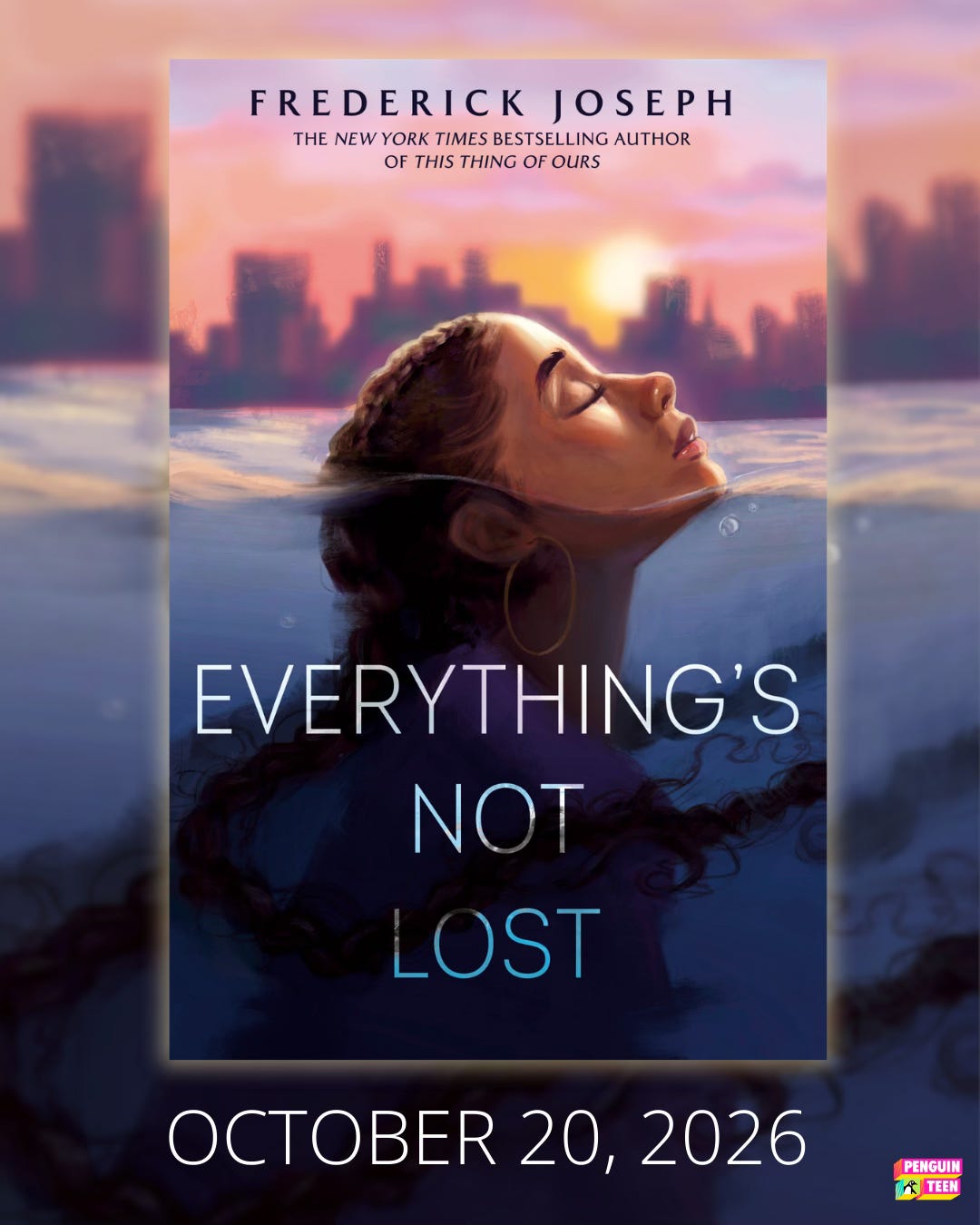
If my work has ever moved you, taught you, or made you feel seen, please consider preordering my novel Everything’s Not Lost or becoming a paid subscriber. I keep my writing free because I believe in access, but sustaining that vision takes support. Your contribution helps me keep creating with care and honesty.
Frederick, I awoke to this piece this morning having forgotten the date and already having forgotten why this broken, almost dead “democracy” ever had reason to celebrate. I have come to realize that celebrations are more often a tool of control, a collective, annual hypnotism that doses you with just enough euphoria to forget the ills of history, organized religion, and the culture that is built around the power of the few, the oligarchy of the national narrative, religious doctrine, and a culture that convinces the hypnotized that the ugly underbelly of a powerful organization, be it religious or system of government, caste or racial hierarchy, does not exist because the euphoria cannot be disturbed or challenged.
I have never, by nature, been “all in” on narratives fed me by collectives or groups convinced that their willing consumption of the elixirs of amnesia would be my salvation. Your narrative captures so vividly the cost of collective surrender. And that surrender comes with a terrible cost to the powerless.
A family denied justice and the power of generational wealth was not, however, wiped off the slate because the power of truth could not be generationally silenced. Your work has deftly reminded us that not all that is shiny is gold, and that suffering is the currency of truth. I will walk through this “holiday” acknowledging that reality and celebrating the fact that truth may be battered and bloody, but it will always be preserved by those with the courage to speak it. Thank you for that.
Powerful essay. Thank you.